


An Air Conditioner Tripping the Circuit Breaker Usually Is Not a Dead Compressor
If you have an air conditioner tripping the circuit breaker every time it runs, the good news is that the most expensive possible cause is also one of the least likely. On a recent job in Tranmere, a 21 year old ducted system was cutting its breaker within minutes of starting up. The compressor, the part whose failure normally ends a system’s life, tested perfectly healthy. The real causes were rainwater getting into a cracked outdoor isolator, and a tired circuit breaker that had started tripping below the current it was rated to carry. The repair came to under $500, against a replacement system that would have run well into five figures.
This article walks through that job step by step, including what we ruled out and why, so you can understand what a proper diagnosis looks like before anyone quotes you for a new system.
The Job In Brief
- System: Temperzone ducted, three phase, installed 2005, running R22 refrigerant
- Suburb: Tranmere, South Australia
- Symptom: Breaker tripping after the system had been running for a while
- Ruled out: Wiring short, compressor failure
- Root cause: Two faults. Rainwater entering a cracked outdoor isolator and tracking onto one phase, plus a circuit breaker that had stopped holding a load it previously carried
- Fix: Isolator dried and resealed, three phase breaker replaced, system retested under load
- Cost: Under $500 all up, including the $199 fault finding call out (July 2026)
- Verdict: Repaired, not replaced
The Symptom: Power, Then Nothing
The homeowner’s description was simple. The ducted system would start, run for a while, and then the breaker in the switchboard would trip and the whole unit would go dead. Resetting the breaker brought it back, for a while, and then it happened again.
That pattern matters. A breaker that trips immediately on start-up points in a different direction to one that trips after a period of running. Intermittent tripping under load is the signature of something that changes with heat, vibration, moisture or time, rather than a hard short that would fault instantly.
What We Ruled Out First (And Why This Matters)
On a system past its twentieth birthday, the temptation is to skip straight to “it’s had its day”. We test first, because the test results are what turn a guess into a diagnosis.
- A wiring short. We inspected and tested the circuit for shorts. Nothing found. That immediately ruled out the most common assumption behind a tripping breaker.
- The compressor. We ran an insulation resistance test, commonly called a megger test, on the compressor windings. This is the check that genuinely does decide whether a system is worth keeping. All readings came back healthy, and phase to phase resistance was consistent across all three phases. This compressor had life left in it.
An insulation resistance test works by applying a controlled DC voltage to the motor windings and measuring how much current leaks away through the insulation. As test equipment manufacturer Fluke explains it:
“An insulation resistance tester supplies ‘nondestructive’ DC voltage to the windings and insulation points of a motor to measure the current leakage rate“, Fluke, test and measurement equipment manufacturer
A failing compressor leaks current to earth, and the reading gives it away long before the unit dies completely. A healthy reading, as we had here, is the strongest single argument for repairing rather than replacing. If you are weighing that decision on your own system, our repair or replace calculator is a useful starting point, though nothing beats an actual test on the actual unit.
The First Real Fault: Water In the Isolator
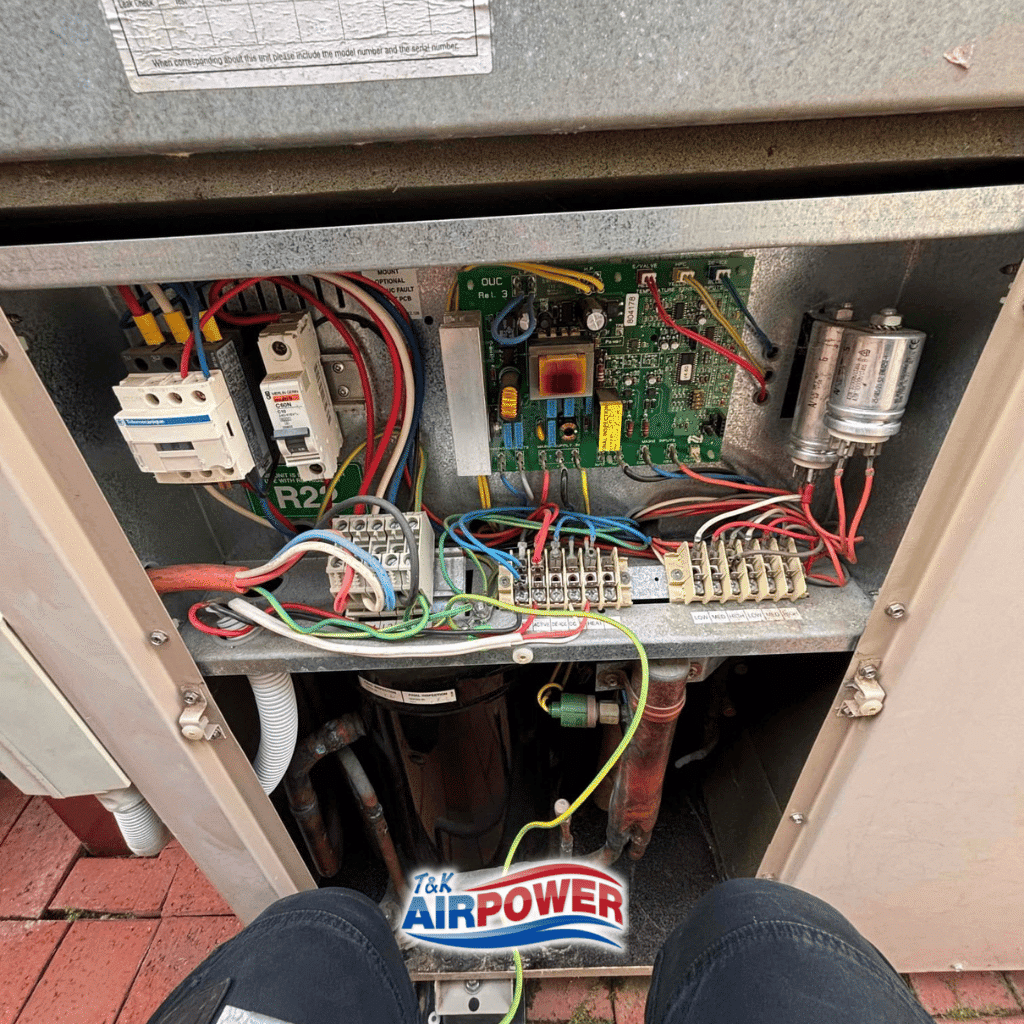
With the expensive causes eliminated, we moved to the outdoor unit. The isolator, which is the weatherproof switch that lets the system be safely powered down for servicing, had a crack in the top of its housing. Rain had been getting in through that crack, pooling inside, and finding its way onto one of the three phases.
Water sitting on a live phase is exactly the sort of intermittent leakage that trips a breaker without leaving any obvious trace. It is also a genuine safety issue rather than just an inconvenience. We dried the housing out and sealed the crack.
That isolator is not an optional extra. Australian wiring rules require one, as Fujitsu General Australia sets out in its AS/NZS 3000 compliance guidance:
“Air-conditioning and heat pump systems incorporating a compressor shall be provided with a lockable isolating switch installed adjacent to the unit“, Fujitsu General Australia, on AS/NZS 3000 compliance
After 21 South Australian summers and winters, UV and heat cycling had made that plastic housing brittle. This is ordinary weathering on any outdoor electrical enclosure of that age, not a fault with the unit itself.
The Second Fault: A Breaker That Had Given Up
Here is where a lot of repairs would have stopped, and where the customer would have called us back a week later.
With the isolator sealed, we ran the system for about 20 minutes to prove the fix. It tripped again, this time at a measured peak draw of 14.5 amps. By that point the wiring had tested clear, the compressor had tested healthy and the water problem was resolved, which left the breaker itself as the remaining variable. Breakers are mechanical devices. Repeated tripping stresses the internal mechanism, and a breaker that has cut out many times can end up dropping a load it used to carry without complaint.
We replaced the three phase breaker, retested the system under full load, and it ran clean.
Two faults, stacked one on top of the other. The water ingress caused the original tripping, and all that repeated tripping wore out the breaker. Fixing only the first fault would have left the homeowner with a system that still cut out for no apparent reason. This is the practical reason we always prove a repair under load before we leave, rather than fixing the obvious thing and packing up.
The Job At a Glance
| Stage | What we checked | Result |
|---|---|---|
| Ruled out | Circuit inspected and tested for shorts | Clear, no short found |
| Ruled out | Compressor insulation resistance (megger) and phase to phase resistance | Healthy on all three phases |
| Fault 1 | Outdoor isolator housing | Cracked, water pooled inside and tracking onto phase 3 |
| Fault 2 | System run under load for 20 minutes | Breaker tripped again at 14.5A measured peak draw, with all other causes eliminated |
| Outcome | Isolator dried and sealed, three phase breaker replaced, retested | Ran clean, repaired for under $500 |
Common Causes of an Air Conditioner Tripping the Circuit Breaker
The Tranmere job covered two of these. The full list a technician works through usually includes:
- Water ingress at the outdoor isolator, junction boxes or cable entries. Very common on older installations, and the cause is usually a cracked or perished enclosure.
- A degraded circuit breaker that has tripped too many times and now trips below its rating.
- Compressor winding failure, which an insulation resistance test will confirm or eliminate.
- A failing capacitor or contactor causing high start-up current draw.
- A dirty or blocked outdoor coil, which makes the system work harder and pull more current. Our guide to outdoor unit air flow issues covers this in detail.
- Genuine wiring faults, including rodent damage and degraded insulation.
- An undersized or shared circuit, which is more common where a system has been upgraded without the switchboard being reviewed.
Only the first two applied here, which is precisely why guessing is expensive. If your system is tripping and you want it looked at properly, our air conditioner repairs team can diagnose it, and for homes in the eastern suburbs we cover air conditioning repairs across the Campbelltown council area including Tranmere.
Is It the Breaker or the Safety Switch?
These get used interchangeably in conversation, and they are different devices doing different jobs. A circuit breaker protects against overload and short circuit, by current. A safety switch, or RCD, protects people, by detecting current leaking to earth.
Knowing which one is tripping tells a technician a lot before they even open anything. We have covered this in more depth in our guides to why your safety switch keeps tripping and the differences between ceramic fuses, circuit breakers, RCDs and AFDDs. If your switchboard is of a similar vintage to the system it feeds, a switchboard upgrade is worth discussing at the same time.
What You Can Check Yourself, Safely
There is very little a homeowner should be doing inside a switchboard or an isolator, and nothing that involves opening either one. What you can do:
- Look at the isolator next to your outdoor unit, once or twice a year and especially before summer. You are looking for cracks, brittleness, discolouration or a lid that no longer seats. Do not open it. Just look.
- Note the pattern. Does it trip instantly, or after running for a while? Only on hot days? Only when it rains? That detail genuinely shortens the diagnosis.
- Keep the outdoor unit clear of leaf litter and growth, so it is not working harder than it needs to.
- Do not keep resetting a tripping breaker. Every trip has a cause, repeated resets wear the breaker itself, and if water is involved it is a safety issue.
Anything past that point needs a licensed technician, which is also the government’s advice on air conditioning generally:
“Book a regular service by a licensed technician to make sure your appliances operate efficiently“, energy.gov.au, Australian Government Department of Climate Change, Energy, the Environment and Water
Regular air conditioner servicing is also when a cracked isolator gets spotted, months before it puts water onto a live phase in the middle of a heatwave.
Repair or Replace?
Repaired, and comfortably so. The deciding factor was not the age of the system, it was the compressor test result. Strong windings and consistent phase to phase resistance on a unit that had been looked after meant the expensive component was sound, and everything else was serviceable.
The refrigerant matters here too. This system runs R22, which was standard on units of its era and is now well into phase out. That cuts both ways. This fault was purely electrical, nothing to do with the refrigerant circuit, which is exactly why it was worth fixing and why the repair was inexpensive. But the day an R22 system needs a regas or a compressor, the economics shift sharply, because the refrigerant is increasingly scarce and costly. We have written about that trade-off in our guide to the R410A phase out and whether to repair or replace, and the same logic applies with more force to R22.
So the rule we work to is simple. Fix the electrical and mechanical faults on an older system while the sealed refrigerant circuit is sound, and start planning a replacement once that circuit is what needs the money. On this job a sub $500 repair bought the homeowner more years out of a working system, and that is the call we make by default.
Our fault finding on domestic air conditioning is a flat $199 call out, which covers a technician attending and properly diagnosing the fault rather than guessing at it. Repairs are quoted before any work goes ahead. On this job the isolator repair and breaker replacement together brought the total to under $500 including the call out. Prices are correct at July 2026 and vary with the parts involved and the condition of the switchboard, so treat that as a guide and confirm against a real quote. Our published price list sets out the current rates.
Frequently Asked Questions
Why does my air conditioner keep tripping the circuit breaker?
The most common causes are water getting into the outdoor isolator or wiring, a circuit breaker that has degraded and now trips below its rating, a failing compressor, a faulty capacitor or contactor drawing high start-up current, or a blocked outdoor coil making the system work harder. Only a proper diagnosis separates them, and the pattern of tripping is a strong clue. Our repairs team can test rather than guess.
Does a tripping breaker mean I need a new air conditioner?
Usually not. The fault that genuinely ends a system’s life is compressor failure, and that is confirmed or eliminated with an insulation resistance test. On the Tranmere job described above, a 21 year old system tested healthy and was repaired for under $500. Age raises the odds of a problem, it does not diagnose one.
How much does it cost to fix an air conditioner that trips the breaker?
T&K Airpower charges a flat $199 fault finding call out on domestic air conditioning, and quotes the repair before any work proceeds. The repair itself depends on the cause. A sealed isolator is minor, a breaker replacement is moderate, and a compressor replacement is a much larger job. The example in this article came to under $500 all up. Figures are a guide only, correct at July 2026, and should be confirmed with a quote. See our prices page.
Is it safe to keep resetting the breaker?
No. A breaker trips because something caused it to, and repeated resetting both leaves that cause unaddressed and wears out the breaker. If water is involved, as it was in this case, resetting re-energises a circuit with water on a live phase. Get it diagnosed. Our domestic electrical repairs team handles the switchboard side.
What is the difference between a circuit breaker and a safety switch?
A circuit breaker protects the wiring against overload and short circuit by monitoring current. A safety switch, or RCD, protects people by detecting current leaking to earth and cutting power in milliseconds. They do different jobs, and which one is tripping tells a technician a great deal. See our guide to fuses, circuit breakers, RCDs and AFDDs.
Can a circuit breaker itself go bad?
Yes. A breaker is a mechanical device, and repeated tripping stresses its internal mechanism. Over time some breakers begin dropping loads they previously carried without trouble. On this job the system still tripped at a measured 14.5 amps peak draw once every other cause had been eliminated, and replacing the breaker resolved it. Replacing a breaker is straightforward, but it should only be done after the original cause of the tripping has been found and fixed, otherwise the new breaker simply inherits the same problem.
Why does my air conditioner only trip the breaker when it rains?
That pattern strongly suggests water ingress somewhere in the outdoor electrical path, most often a cracked or perished isolator housing, a failed cable gland, or a junction box that is no longer sealed. It is a common fault on older installations and it is a safety issue as well as a nuisance. It needs a licensed technician, not a reset.
Do I need an isolator switch for my air conditioner?
Yes. Under Australian wiring rules, air conditioning and heat pump systems with a compressor must have a lockable isolating switch installed adjacent to the unit. It is what allows the system to be safely isolated for service, and it must be in serviceable condition, which includes being weatherproof.
Need Help With an Air Conditioner That Keeps Tripping?
If your system is tripping the breaker, the useful next step is a proper diagnosis rather than a replacement quote. We test the compressor before we talk about replacing anything, because that test is what turns an opinion into an answer.
Give our team a call on 08 8296 7888 or contact us online to book a fault finding visit. If you would like to read more first, our guide on what to do when your air conditioner is not working covers the basics you can safely check yourself.
T&K Airpower has kept Adelaide homes comfortable since 1996. As authorised warranty agents for Mitsubishi Electric, Temperzone and Hitachi, our licensed, repair first team diagnoses the fault properly and fixes what is actually broken.
Is your air conditioner showing a fault code? Check what it means with our free air conditioner fault code lookup, covering more than 1,000 codes across 15 brands sold in Australia.

)