
The R410A Phase-Out, in Plain English
If your air conditioner is more than about eight years old, it almost certainly runs on R410A refrigerant, and the R410A phase-out now changes the maths on repairs. R410A is being wound down across Australia because of its high global warming potential, which means it is getting scarcer and more expensive to buy. For a healthy system a small repair still makes sense. But when an older R410A unit springs a refrigerant leak, replacement is increasingly the smarter long-term call.
This guide explains what the phase-out actually is, why it is pushing regas prices up, and how to make a calm, sensible repair-or-replace decision for your home. No panic required, just the facts and a clear path forward.
What Is the R410A Phase-Out?
R410A is a hydrofluorocarbon (HFC) refrigerant used in most split system and ducted air conditioners sold over the past 15 years or so. The problem is its environmental impact: R410A has a global warming potential (GWP) of 2,088, meaning a kilogram of it traps over 2,000 times more heat than a kilogram of carbon dioxide.
To cut those emissions, Australia is running an HFC phase-down, a staged reduction in how much of these gases can be imported each year.
“The HFC phase-down is a gradual reduction in the maximum amount of HFCs permitted to be imported into Australia, which started on 1 January 2018.“, Department of Climate Change, Energy, the Environment and Water
The plan reduces permitted HFC imports by 85% between 2019 and 2036, managed through an annual import quota that shrinks year on year. R410A, as one of the highest-GWP gases still in wide use, feels that squeeze first. On top of the import quota, from 1 July 2025 it became illegal to import or manufacture new small, non-ducted split systems (with a refrigerant charge of 2.6 kg or less) that use a refrigerant with a GWP above 750. That rules out R410A in those units and points the whole industry toward lower-GWP replacements.
Why R410A Is Getting Expensive and Hard to Get
The phase-out does not flick a switch and ban R410A overnight. Instead, the supply tap is slowly closing while plenty of existing systems still need topping up, so the price of a regas climbs. Refrigerant supplier Beijer Ref, who supply much of the trade here in Adelaide, put it plainly.
“R410A is likely to see constrained supply throughout and beyond 2026.”, Beijer Ref, refrigerant wholesaler
That tightening is already underway. Australia’s import quota was cut by a further 19% on 1 January 2026, and industry body Refrigerants Australia expects the months heading into summer to be the most pressured, when demand peaks just as the quota year runs down. None of this means R410A vanishes tomorrow, but it does mean every regas on an old system is likely to cost more than the last one, with the occasional moment of genuine scarcity.
The Refrigerants Replacing R410A
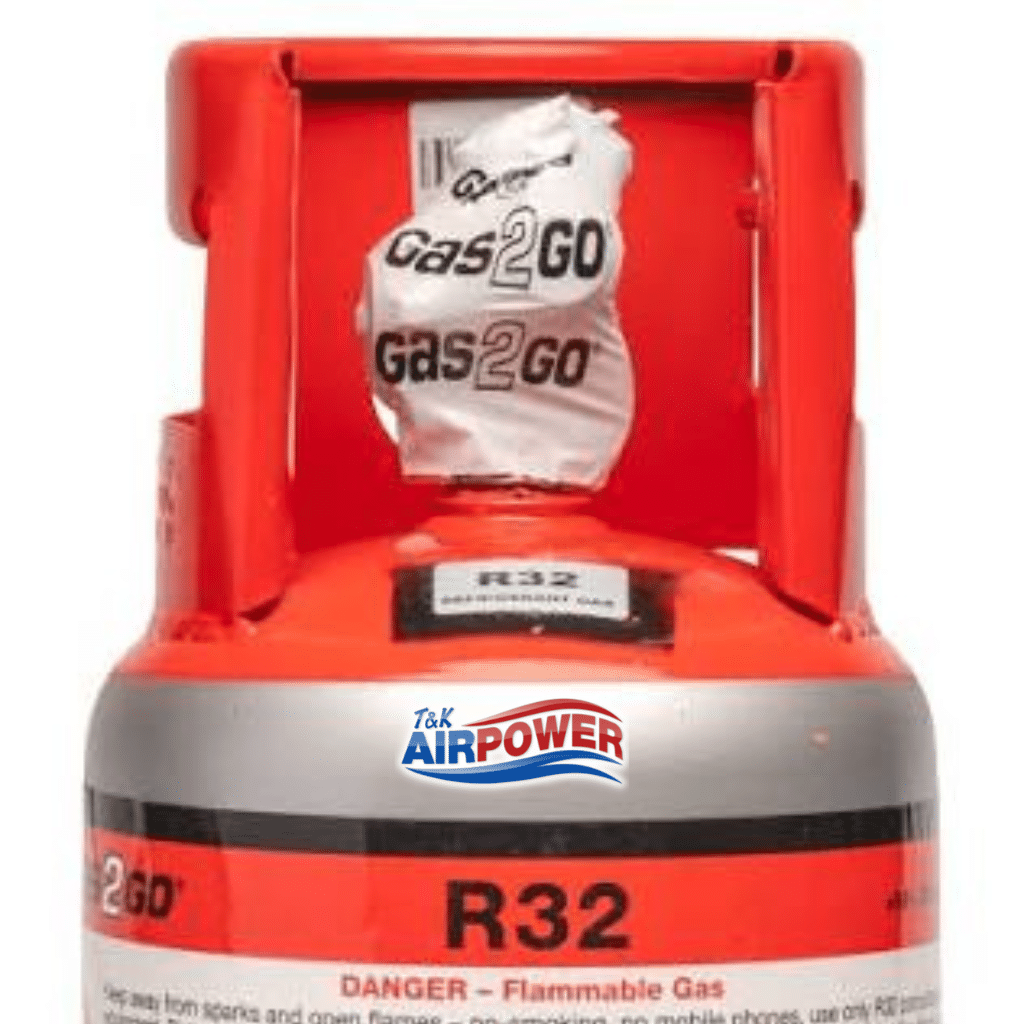
New air conditioners have already moved on. Manufacturers including Mitsubishi Electric, Daikin, Fujitsu, Panasonic and Samsung now build most new split systems with R32, and larger or ducted systems are shifting to blends like R454B. Here is how they compare.
| Refrigerant | GWP | Where you will find it | Long-term outlook |
|---|---|---|---|
| R410A | 2,088 | Older split and ducted systems (roughly pre-2020) | Being phased down; no longer used in most new equipment |
| R32 | 675 | The standard in most new split systems | Supported long term |
| R454B | 466 | Newer ducted and larger systems | Supported long term |
| R452B | 698 | Some new systems | Supported long term |
A common question is whether your existing R410A unit can simply be “converted” to R32. Unfortunately not. R32 and R454B run at different pressures and use different lubricating oils, so they are designed into new equipment from scratch rather than swapped into old units. Moving to a low-GWP refrigerant means a new system, not a refill.
So, Repair or Replace? A Practical Guide for Adelaide Homes
This is the decision that actually matters at your place, and it is not all-or-nothing. The phase-out only changes the picture when a fault involves losing refrigerant. Most air conditioner faults do not. A failed fan motor, a faulty control board, a blocked drain or a tripped capacitor have nothing to do with the gas and are usually well worth repairing.
The calculation shifts when an older R410A system develops a refrigerant leak, because the repair now means paying a premium for an increasingly scarce gas, on a unit that is already near the back half of its life.
| Your situation | Usually worth repairing | Lean toward replacement |
|---|---|---|
| Electrical or mechanical fault, no gas involved (board, fan, sensor, capacitor) | Yes | |
| Small leak on a newer, otherwise healthy system | Yes (fix the leak, then regas) | |
| Refrigerant leak on an R410A system over roughly 10 years old | Weigh it carefully | Often yes |
| Repeated or large leaks, or a failed compressor on an old unit | Yes |
A few honest pointers we share with customers:
- Always fix the leak, never just top up. Repeatedly refilling a leaking system wastes expensive gas and is poor practice. The leak must be found and repaired first.
- Factor in efficiency. A new R32 system is typically more energy efficient than a decade-old R410A one, so part of the replacement cost comes back as lower running costs. See our guide to the cost of running your air conditioner.
- Get a proper diagnosis first. Before any talk of replacement, you want to know exactly what has failed. That is what our air conditioner repair service is for.
If you are unsure where your unit sits, the simplest step is to book a diagnostic and let a licensed technician tell you honestly whether a repair stacks up.
Why a Licensed, Repair-First Technician Matters Now
Handling refrigerant in Australia is regulated work, and only ARC-licensed technicians are legally allowed to recover, repair and recharge a system. As the phase-out tightens, the value of a reputable, authorised repairer only grows: you want someone who will fix the genuine fault, give you a straight repair-or-replace answer rather than an automatic upsell, and size any new system correctly the first time.
T&K Airpower has always taken a repair-first approach, and as authorised warranty agents for Mitsubishi Electric, Temperzone and Hitachi we will tell you when a fix is worth it. When replacement genuinely is the better value, our air conditioner installation team can move you onto an efficient R32 system.
Frequently Asked Questions
Is R410A banned in Australia?
Not outright. R410A is being phased down through annual import quotas rather than banned, so existing systems can still be repaired and regassed for now. However, new small non-ducted split systems using refrigerant with a GWP above 750 (which includes R410A) can no longer be imported or made here as of 1 July 2025.
Will my R410A air conditioner stop working?
No. Your system will keep running normally. The phase-out affects the price and availability of the gas for future repairs, not the operation of a unit that is working fine today.
Can my R410A system be converted to R32?
No. R32 runs at different pressures and uses different oils, so it cannot be retrofitted into R410A equipment. Switching to a low-GWP refrigerant means a new system.
How much does an air conditioner regas cost now?
It varies with the type and size of system and how much gas is needed, and R410A regas prices are rising as supply tightens. We do not quote a flat figure because a regas should always follow a leak repair. The honest answer is to get the fault diagnosed and a written quote. Contact us for an estimate for your unit.
My older AC has a gas leak. Should I just replace it?
Often, yes, but not always. If the unit is over roughly ten years old and the leak is significant, replacement with an efficient R32 system is frequently the better long-term value. If it is newer or the fault is minor, repairing the leak can still make sense. A diagnostic visit gives you the real numbers.
What refrigerant do new air conditioners use?
Most new split systems use R32 (GWP 675), while newer ducted and larger systems increasingly use blends such as R454B (GWP 466). Both are far lower in global warming potential than R410A.
Does this affect ducted systems too?
Yes, over time. The 1 July 2025 equipment rule targeted small non-ducted splits first, but the broader import phase-down covers R410A across all system types, so ducted units that rely on it will face the same rising regas costs. Our ducted air conditioning guide explains the trade-offs.
Need Help Deciding?
If your air conditioner has thrown a fault or is low on gas, the smartest move is a proper diagnosis before you spend a cent on refrigerant. Give our team a call on 08 8296 7888 or contact us online and we will tell you honestly whether a repair or a replacement is the better value for your home.
T&K Airpower has kept Adelaide homes comfortable since 1996. As authorised warranty agents for Mitsubishi Electric, Temperzone and Hitachi, our licensed, repair-first team fixes what is worth fixing and only recommends replacement when it genuinely saves you money in the long run.
Try it yourself: Deciding whether to fix or upgrade? Try our free repair or replace calculator for a quick guide.
Is your air conditioner showing a fault code? Check what it means with our free AC fault code lookup, covering more than 1,000 codes across 15 brands sold in Australia.