


Written by Oliver Hastings on 14 October 2026
Why Does a Reverse Cycle Air Conditioner Show a P8 Fault Code?
A reverse cycle air conditioner P8 fault repair in Kurralta Park traced back to a leaking Schrader valve core at the outdoor unit, which had allowed the refrigerant charge to drop to approximately 50% of the required level. We replaced the faulty valve core, recovered the existing refrigerant, and recharged the system with R438A retrofit refrigerant. The unit returned to service, with the customer signing a waiver acknowledging the limitations of the repair approach they chose.
The Job In Brief
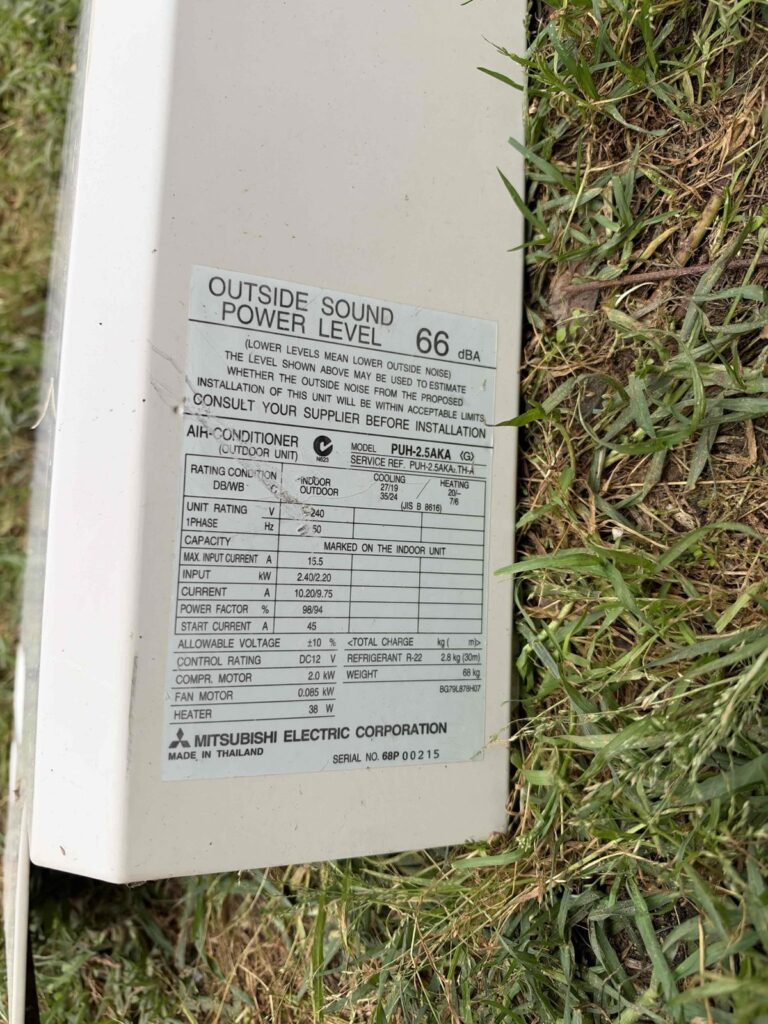
- System: Mitsubishi Electric reverse cycle ducted air conditioner, outdoor unit model PUH-2.5AKA
- Suburb: Kurralta Park, South Australia
- Symptom: P8 error code on controller; IC and 01 on self-check test; system had been shut down
- What we tested: Outdoor unit lockout fault codes; refrigerant pressures at the outdoor service port; visual inspection of service fittings
- Root cause: Leaking Schrader valve core at the outdoor unit service port; system approximately 50% undercharged; outdoor unit locked out on PA fault
- Fix: Replaced Schrader valve core; recovered existing refrigerant; recharged with correct quantity of R438A retrofit refrigerant; system recommissioned
- Price guide: About $1,500 to $2,000 inc GST for the repair, plus a $199 diagnostic fee (correct at 12 October 2026)
- Outcome: System operational; wall controller on/off button fault unrepaired; customer signed waiver acknowledging retrofit limitations and approximately 70% efficiency
The Fault
The customer contacted us after their Mitsubishi Electric reverse cycle system had been out of service for some time. The controller was displaying a P8 error code, and a self-check test had shown IC and 01. Their booking request asked whether the system was repairable and whether repair made more sense than replacement.
On site, we found the outdoor unit locked out on a PA fault. The two codes are connected: a P8 fault is displayed on the indoor controller when the indoor coil sensor does not detect a temperature change within approximately nine minutes of the compressor starting. If the outdoor unit is locked out and the compressor is not running, the P8 follows. The PA fault indicates the outdoor unit has forced the compressor to stop to prevent damage. On this system, the PA fault was the primary fault; the P8 was a downstream consequence of it.
What We Tested
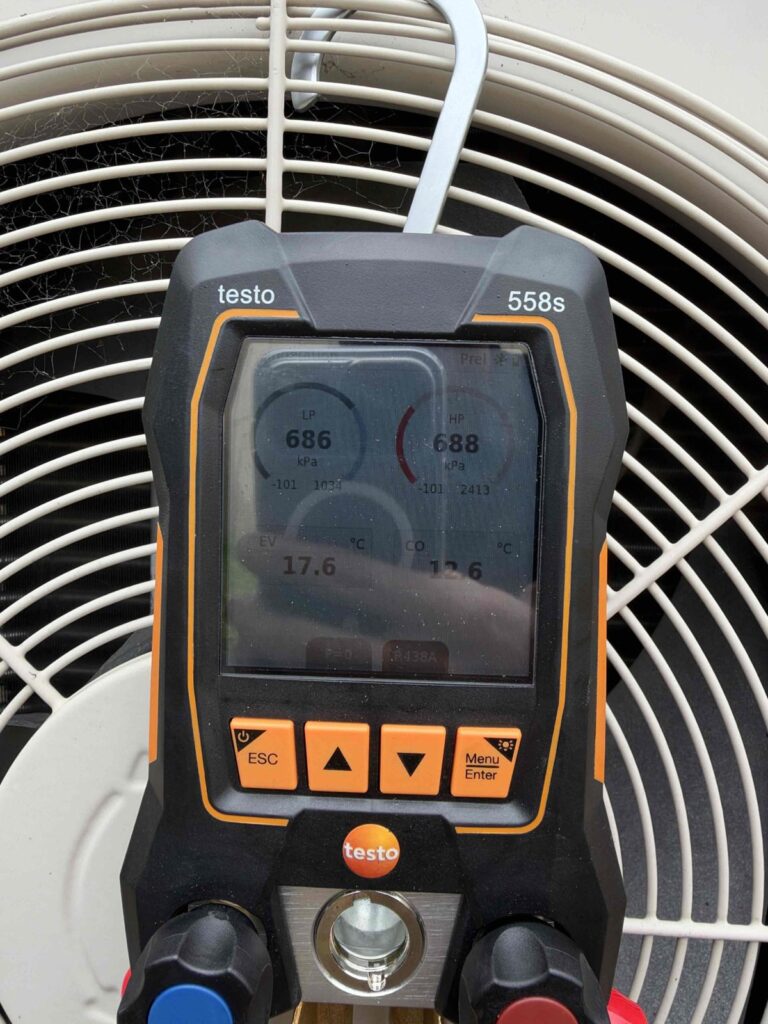
Refrigerant pressures. We measured the refrigerant pressures at the outdoor unit service port. The system was significantly undercharged, at approximately 50% of the required charge. A refrigerant circuit operating at half its design charge produces abnormal operating pressures. The outdoor unit responds to this by locking out the compressor to prevent damage, which is the PA fault. This finding was consistent with the fault codes reported.
Leak source inspection. Further inspection of the outdoor unit identified a leaking Schrader valve core at the service port. Schrader valves are the access fittings on a refrigerant circuit, used by technicians to connect gauges and to recover or add refrigerant. They use a spring-loaded pin mechanism, similar in principle to a tyre valve core. Research published in an HVAC engineering journal has found that used Schrader valve cores can leak at rates ranging from a few grams per year to more than 9,000 grams per year, depending on the condition of the core and whether a gasketed cap is fitted. The protective cap is the primary seal on the valve; without it, a leaking core can deplete the refrigerant charge over months or years before any obvious performance drop is noticed.
How We Fixed It
The customer was advised of the faults and the repair options. Due to budget constraints, they chose to proceed with minimum-cost repairs. The quote was titled Band-Aid Mechanical Repairs (Not Recommended), a designation that reflects the repair approach rather than any judgment of the customer. A fully correct repair would have included replacing the wall controller and addressing all outstanding faults. The work actually carried out is described below.
We replaced the leaking Schrader valve core at the outdoor unit. The existing refrigerant was then recovered from the system, and the correct quantity of R438A retrofit refrigerant was charged into the system. R438A is a hydrofluorocarbon (HFC) blend with zero ozone depletion potential, manufactured by Honeywell under the trade name Solstice N40. It is used as a retrofit replacement in ducted air conditioning systems that originally operated on R22, a refrigerant that has been phased out in Australia due to its ozone-depleting properties. R438A is compatible with existing mineral oil lubricant in most systems, which reduces the cost and time required for the retrofit compared to options that require an oil change.
All refrigerant recovery and recharge work must be carried out by a technician holding a current Refrigerant Handling Licence (RHL) issued by the Australian Refrigeration Council (ARC). Under the Ozone Protection and Synthetic Greenhouse Gas Management Regulations 1995, handling fluorocarbon refrigerant without the appropriate ARC licence is a strict liability offence. Refrigerant cannot legally be vented to atmosphere; recovery before recharge is mandatory.
The system was recommissioned after the recharge.
| Stage | What we did | What it showed |
|---|---|---|
| Fault code check | Read PA lockout on outdoor unit; cross-referenced with P8 on indoor controller | Outdoor unit had forced the compressor to stop |
| Pressure check | Measured refrigerant pressures at the outdoor unit service port | System approximately 50% undercharged |
| Leak identification | Inspected outdoor unit service port fittings | Leaking Schrader valve core identified as the source of refrigerant loss |
| Repair | Replaced Schrader valve core; recovered existing refrigerant; recharged with R438A | System pressure restored to correct level |
| Recommission | Ran system through start-up | System operational; approximately 70% efficiency noted in customer waiver |
Key Takeaways
- P8 is a symptom, not a root cause. On Mitsubishi Electric ducted systems, the P8 code on the indoor controller means the outdoor unit is not running. The actual fault is on the outdoor board. A self-check will return a separate code, such as PA, which is the starting point for diagnosis. Do not assume the indoor unit is at fault.
- Refrigerant loss from a valve leak can be very gradual. A leaking Schrader valve core may release refrigerant slowly over months before the charge drops far enough to trigger a lockout. If your system has been noticeably less effective at heating or cooling before faulting out, a refrigerant check is a reasonable first step when the technician arrives.
- What you can safely check yourself. Confirm the isolator switch at the outdoor unit is on, check that the circuit breaker for the system has not tripped, and write down any fault codes displayed on the controller before calling a technician. Do not attempt to open refrigerant circuit fittings or add refrigerant yourself; this requires a licensed technician and the appropriate equipment.
- A retrofit refrigerant is not the same outcome as a full re-gas with the original refrigerant. R438A can return an older system to service, but the customer in this job signed a waiver acknowledging approximately 70% efficiency compared to a fully serviced system. If a system is old enough to require a retrofit, it is worth using our repair or replace calculator before committing to the repair cost.
- Additional faults found during a repair will be disclosed, whether or not budget allows them to be fixed. On this job, a faulty wall controller on/off button was identified and quoted. The customer is operating the system via the test-run function in the interim. The controller replacement remains open for approval.
The Resolution
The system was recommissioned and is now operational. The customer signed a waiver acknowledging the limitations of the retrofit refrigerant, an approximate 70% efficiency compared to a fully serviced system, and the need to replace the wall controller to rectify the control fault. The wall controller on/off button remains unrepaired; the customer is currently operating the system via the test-run function.
A replacement Par41 wall controller was quoted during the visit and remains open for approval. If you are weighing up the options for a ducted air conditioning system of similar age, our technicians can give you a frank assessment at the time of inspection. Our repair or replace calculator is also a useful starting point before committing to a repair quote.
“A fault code is your system asking for help. The sooner it gets looked at, the better the chance of a straightforward repair.”
Oliver Hastings, T&K Airpower
Frequently Asked Questions
What does a P8 fault code mean on a Mitsubishi Electric air conditioner?
P8 is displayed on the indoor controller when the indoor coil sensor does not detect a temperature change within approximately nine minutes of the compressor starting. It indicates the outdoor unit is not working as expected, not that the indoor unit has failed. The actual cause is identified by reading the outdoor unit fault codes. See our dedicated page on the Mitsubishi Electric P8 fault for more detail.
What is a PA fault on a Mitsubishi Electric ducted system?
PA indicates a forced compressor error: the outdoor unit has detected an abnormal condition and shut the compressor down to prevent damage. Low refrigerant pressure is one possible cause. A licensed technician needs to diagnose the specific reason before any repair work begins. Our page on the Mitsubishi Electric PA fault covers the common causes in more detail.
What is R438A and why was it used instead of the original refrigerant?
R438A is a hydrofluorocarbon blend with zero ozone depletion potential, used as a retrofit replacement in systems that originally operated on R22. R22 is an ozone-depleting refrigerant that has been phased out in Australia. When an older system requires a re-gas and R22 is no longer the practical option, R438A is a compatible retrofit refrigerant. It is compatible with existing mineral oil lubricant in most systems, which reduces the cost of the retrofit. The trade-off is a reduction in efficiency compared to the original refrigerant, which should be understood and acknowledged before proceeding.
Can I top up my air conditioner refrigerant myself?
No. In Australia, handling fluorocarbon refrigerants requires a current Refrigerant Handling Licence issued by the Australian Refrigeration Council. Under the Ozone Protection and Synthetic Greenhouse Gas Management Regulations 1995, handling these refrigerants without the appropriate licence is a strict liability offence. A licensed technician must also recover any existing refrigerant before recharging; venting refrigerant to atmosphere is not permitted.
What is a Schrader valve on an air conditioner and why does it leak?
A Schrader valve is the service access fitting on a refrigerant circuit, used by technicians to connect gauges and to recover or add refrigerant. The valve core uses a spring-loaded pin, similar in principle to a tyre valve. The core can develop a leak over time, particularly if the protective gasketed cap is missing or if the core was damaged during previous service work. Without the cap in place, a slow leak from the core can deplete the refrigerant charge over months before any fault code appears.
How do I know if my ducted air conditioner is low on refrigerant?
Common indicators include reduced heating or cooling output, longer run times to reach the set temperature, ice forming on pipework or indoor coil, and eventually a lockout fault code. A refrigerant pressure check is one of the standard checks carried out during a ducted air conditioning service. Catching a slow leak during a service is considerably less disruptive than waiting for a lockout fault.
Should I repair or replace an older ducted system that needs a refrigerant retrofit?
It depends on the age of the system, the total repair cost, and the cost of a replacement. A retrofit can return a system to service at lower upfront cost, but the efficiency reduction and the likelihood of further age-related faults should be factored in. Our repair or replace calculator is a useful starting point, and our technicians can give you a direct assessment at the time of inspection. We repair first, but we will tell you honestly when replacement is the better long-term call.
Need Help?
If your ducted or split system is displaying a fault code, call us on 08 8296 7888 or book a diagnostic online. Our air conditioning repair service covers metropolitan Adelaide and surrounding areas, with a $199 diagnostic fee for residential AC faults.
T&K Airpower has been repairing heating and cooling systems in Adelaide since 1996. We are licensed, ARCtick-certified, and authorised warranty agents for Mitsubishi Electric, Hitachi and Temperzone. We repair first.

