


Written by Oliver Hastings on 23 October 2026
What Causes a Ducted Air Conditioner Refrigerant Leak in Adelaide?
A ducted air conditioner refrigerant leak in Leabrook, Adelaide came to light during a routine service when our technician found the interconnect copper pipework was leaking and both condensate drain lines required replacement and reconfiguration. We replaced the entire pair coil pipe run, installed new positive-pressure drains, recharged the system with 3.9 kg of R32, and replaced three control switches in the same visit.
The Job In Brief
- System: Ducted air conditioner (equipment details not recorded)
- Suburb: Leabrook, Adelaide
- Reported at booking: Routine service and tune-up
- What we found: Both condensate drain lines requiring replacement and reconfiguration; pair coil (interconnect copper refrigerant pipework) leaking
- Fix: Both drain lines replaced to a positive-pressure specification; full interconnect pipework replaced with new pre-insulated copper; system pressure-tested, evacuated and recharged with 3.9 kg R32; light switch, heat switch and fan switch replaced
- Price guide: $5,000 to $5,500 inc GST (guide only, correct at 15 October 2026)
- Outcome: New pipe run held pressure on test; system evacuated below 500 microns and charged
The Fault
The customer contacted us for a general service and tune-up of their ducted system. There were no specific symptoms reported at booking.
On arrival, our technician found two separate issues. Both condensate drain lines needed to be replaced and reconfigured to a positive-pressure arrangement. The pair coil, which is the pre-insulated copper pipe set that carries refrigerant between the indoor and outdoor units through the roof space, was leaking.
Neither fault is visible from the living area. The pair coil runs through the roof space and wall cavities. The drain lines sit above the ceiling. Both issues were identified only when a technician inspected the installation directly.
The customer approved a quote for comprehensive repairs covering full drain replacement, full interconnect pipework replacement, evacuation, and a full recharge with R32. Our air conditioning repairs page covers the range of work this kind of job involves.
What We Tested
During the service inspection, the technician assessed the configuration and condition of both condensate drain lines. In a ducted system, the indoor fan coil unit can sit on the positive-pressure or negative-pressure side of the return-air fan, and each arrangement requires a differently specified drain. A drain that does not suit the unit’s pressure characteristics cannot clear condensate reliably, which can lead to water backing up into the ceiling space over time. Both drain lines on this job required replacement and reconfiguration to a positive-pressure specification.
The pair coil was also inspected and found to be leaking. For more background on how ducted systems are configured, see our ducted air conditioning guide.
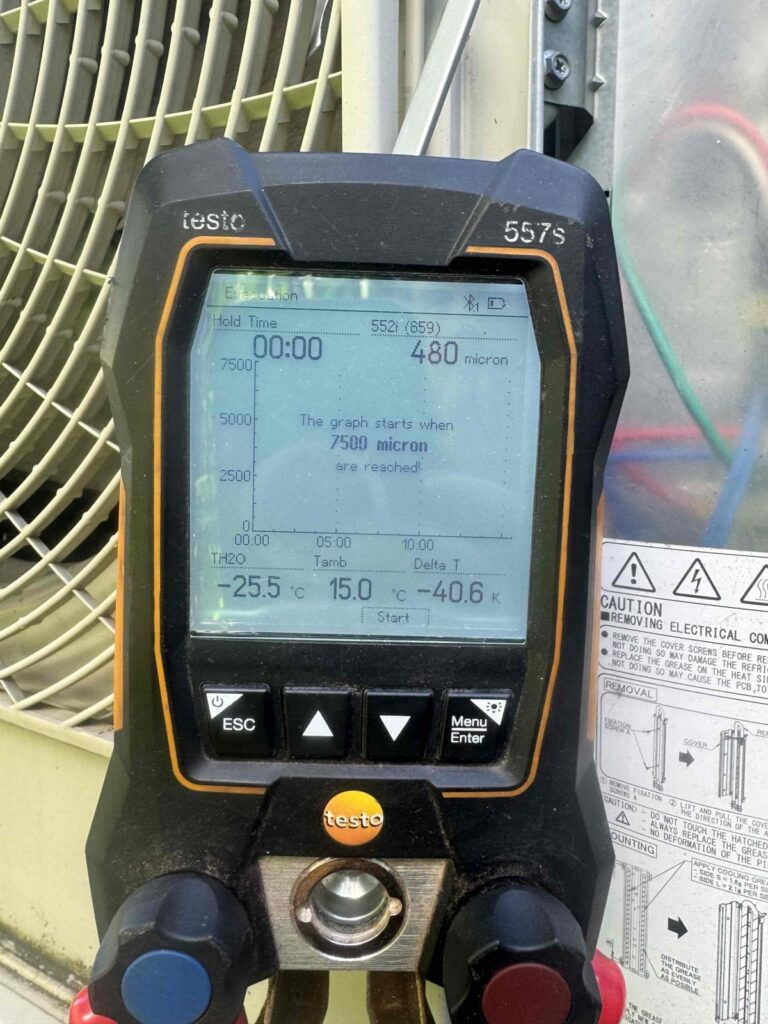
On the repair visit, the new pipe run was pressure-tested once installed. It held pressure, confirming the integrity of the new installation. The system was then evacuated to below 500 microns before charging. In refrigeration practice, a vacuum below 500 microns confirms two things: the circuit is sealed, and moisture has been removed from inside the pipework. Moisture inside a refrigerant circuit can react with refrigerant and compressor oil to form acids that damage internal components. Only once the vacuum held was the system charged with R32.
How We Fixed It
Condensate drainage
Both drain lines were removed and replaced using Aspen UPVC 20 mm drain pipe and 15 mm PVC pressure pipe. The new drains were installed to a positive-pressure specification, which uses the unit’s air pressure to move condensate through the line. The correct drain type must match the unit’s configuration.
Refrigerant pipework
The entire interconnect pipe run was removed and replaced. The new pipework is Ardent FR 10 mm pre-insulated copper, sized across both the liquid line (3/8 inch) and suction line (5/8 inch). The foam insulation layer on Ardent FR pipe reduces thermal loss along the run and limits the conditions under which condensation can form on the pipe surface.
Once the new run was installed and had held pressure on test, the circuit was evacuated to below 500 microns using a vacuum pump, then charged with 3.9 kg of R32. R32 is the refrigerant specified for this system. All refrigerant work was carried out by a technician holding an ARC Refrigerant Handling Licence, as required under Australian law for any work involving controlled refrigerants including R32. The Australian Refrigeration Council sets out the licensing requirements for R32 work in full.
Electrical switches
A new light switch, heat switch, and fan switch were also installed during the repair visit. Switch work in an air conditioning system falls under our electrical repair services.
| Stage | What we did | What it showed |
|---|---|---|
| Service inspection | Assessed drain line configuration | Both drains requiring replacement and reconfiguration to positive-pressure specification |
| Service inspection | Inspected interconnect pipework (pair coil) | Leakage found in refrigerant pipe run |
| Repair | Replaced both drain lines (UPVC 20 mm and PVC 15 mm) to positive-pressure specification | Drain system reconfigured |
| Repair | Removed and replaced full interconnect pipe run with Ardent FR 10 mm pre-insulated copper | New pipework installed |
| Repair | Pressure test of new pipe run | Held pressure, confirming leak-free installation |
| Repair | Vacuum to below 500 microns | Circuit sealed and clear of moisture |
| Repair | Charged with 3.9 kg R32 | System recharged to specification |
| Repair | Installed light switch, heat switch and fan switch | Control switches replaced |
Key Takeaways
- A refrigerant pipe leak in a ducted system is rarely visible from inside the home. The pair coil runs through the roof space and is hidden behind insulation. If your system is running but not cooling as well as it should, low refrigerant from a pipe fault is one possibility a technician can test for.
- Condensate drains must suit the pressure configuration of the indoor unit. A drain arrangement that does not match the unit can allow water to back up rather than drain freely, with potential for water damage in the ceiling space over time.
- You can safely check the return-air filter (usually behind a grille in the ceiling or hallway), confirm the outdoor unit is clear of leaves and debris, and listen for any unusual sounds from the system. Anything beyond that, including anything involving the roof space, refrigerant lines, drain configuration or electrical components, requires a licensed tradesperson.
- In Australia, any work on a refrigerant circuit, including replacing pipework and recharging, requires a technician holding an ARC Refrigerant Handling Licence. R32 is also classified as mildly flammable (A2L), which carries additional safety requirements for handling and charging.
- This job was booked as a routine service with no symptoms reported. Both faults were found on inspection. If a repair quote comes back and you are weighing it against replacement, our repair or replace calculator can help you work through the decision.
The Resolution
The new pipe run held pressure on testing. The system was evacuated below 500 microns and charged with 3.9 kg of R32. Both condensate drain lines were replaced and reconfigured to a positive-pressure arrangement. A new light switch, heat switch and fan switch were installed. No further faults were recorded at the time of the repair visit.
“The jobs that matter most are often the ones that looked routine at booking. Drains and refrigerant pipe runs sit above your ceiling and are not something you can monitor from the thermostat, but they affect how the system performs and what it costs to run.” Oliver Hastings, T&K Airpower
This job was in Leabrook. We look after homes right across the City of Burnside: see air conditioning repairs in Burnside.
Frequently Asked Questions
How do I know if my ducted air conditioner has a refrigerant leak?
Common signs include the system running but not cooling as well as it used to, ice forming on the indoor unit or on the outdoor pipework, and occasionally a faint hissing sound near the refrigerant lines. A technician can confirm with an inspection and pressure check. A ducted air conditioner does not consume refrigerant in normal use: if levels are low, there is a leak somewhere in the circuit.
What is a pair coil on a ducted air conditioner?
The pair coil is the pre-insulated copper pipe set that connects the indoor unit to the outdoor unit. It carries refrigerant between the two components. Most of the run sits hidden in the roof space and wall cavities, which is why leaks are rarely noticed by homeowners until the system’s performance changes. Australian industry publications have documented a pattern of corrosion-related leaks in pair coil pipework across the country in recent years. The HVACR News analysis of the pair coil problem provides useful background on how these leaks develop and what they look like.
Can I top up the refrigerant in my ducted air conditioner myself?
No. In Australia, handling refrigerants including R32 requires an ARC Refrigerant Handling Licence. Adding refrigerant without first finding and repairing the source of the leak is also not a lasting fix: the system will continue losing charge until the pipework is replaced.
What is a positive-pressure drain on a ducted air conditioner, and why does it matter?
Ducted indoor units can be installed on the positive-pressure or negative-pressure side of the return-air fan. Each side requires a differently configured drain. A positive-pressure drain uses the unit’s air pressure to push condensate through the line. A drain arrangement that does not suit the unit type can allow water to back up rather than drain freely, with potential for water to overflow into the ceiling space over time.
What does evacuating a refrigerant system below 500 microns mean?
Before charging a refrigerant circuit, a technician removes all air and moisture from inside it using a vacuum pump. The depth of the vacuum is measured in microns of pressure. Reaching below 500 microns confirms two things: the circuit is sealed with no active leaks, and moisture has been removed. Moisture left inside a refrigerant circuit can react with refrigerant and compressor oil to form acids that damage internal components over time.
Do I need a licensed tradesperson to replace air conditioning switches?
Yes. Electrical work in South Australia, including switch replacement, must be carried out by a licensed electrical contractor. T&K Airpower holds both refrigeration and electrical licences, so the refrigerant and electrical components of a job like this can be handled in a single visit. See our electrical repair services page for more on what falls under this work.
What does a comprehensive ducted air conditioning repair cost in Adelaide?
This job, covering full drain replacement, full interconnect pipework replacement, evacuation and recharge, and electrical switch replacement, carried a guide price of $5,000 to $5,500 inc GST (guide only, correct at 15 October 2026). Scope and pricing vary with the system and what is found on inspection. If the cost of repair is significant relative to the system’s age and condition, our repair or replace calculator can help you work through whether repair makes sense.
Need Help?
Call us on 08 8296 7888 or book online at www.tkairpower.com.au/contact-us.
T&K Airpower has been servicing Adelaide homes since 1996. We hold refrigeration and electrical licences and are authorised warranty agents for Mitsubishi Electric, Temperzone and Hitachi. We are repair-first: we inspect, diagnose and tell you what is needed before any work begins.

