


Written by Oliver Hastings on 12 October 2026
Why Is My Ducted Air Conditioner Making a Loud Rattling Noise From the Roof?
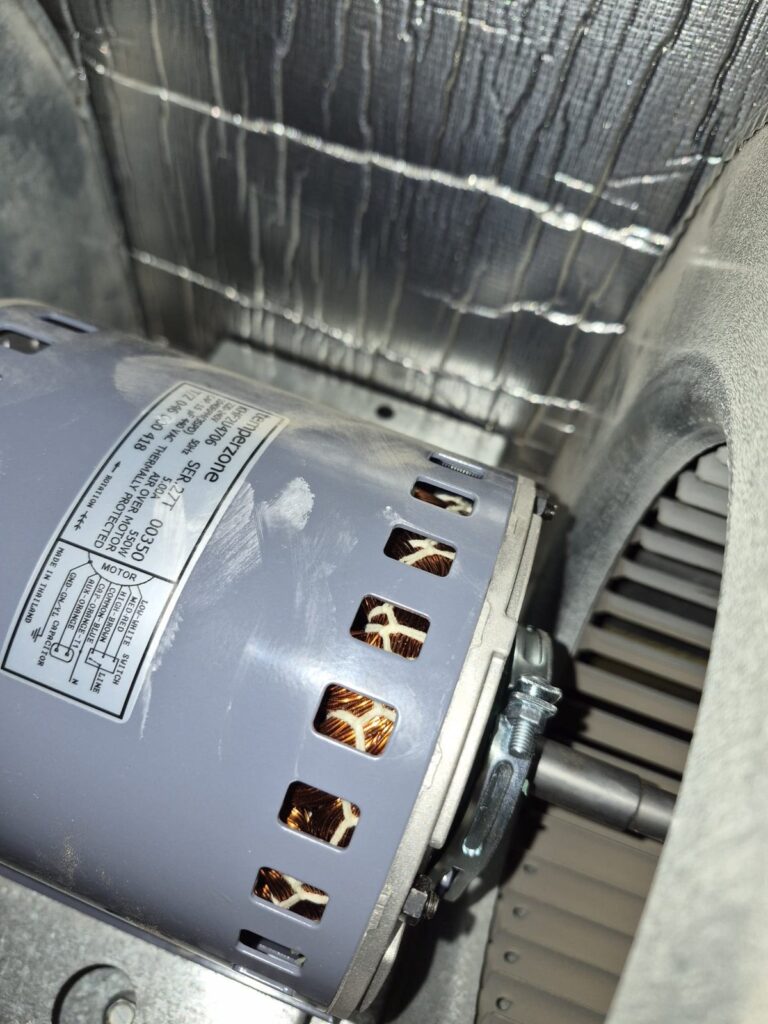
A ducted air conditioner rattling noise from the roof cavity almost always traces back to the indoor fan assembly. At a home in Mawson Lakes, we found deteriorating rubber motor mounts on the indoor fan motor of a Temperzone ducted system. We replaced both indoor fan motors and the impeller, then chemically cleaned the coil, and the indoor fans are now spinning smoothly.
The Job In Brief
- System: Temperzone ISD221Q (indoor) / OSA221R (outdoor), ducted split
- Suburb: Mawson Lakes, SA
- Symptom: Loud vibrating and rattling noise from the indoor unit in the roof cavity
- What we tested: Capacitors, outdoor unit condition, indoor fan motor and rubber mounts
- Root cause: Deteriorating rubber mounts on the indoor fan motor
- Fix: Replaced both 550 W (3/4 HP) indoor fan motors, a 9-inch by 9-inch impeller, and two 10 microfarad capacitors; chemically cleaned the indoor coil
- Price guide: About $4,000 to $4,500 inc GST (guide only, correct at 9 October 2026)
- Outcome: Indoor fans spinning correctly; return air duct replacement quoted as a separate job
The Fault
The customer booked a ducted service and reported a vibrating sound in the roof that was quite loud. On the first visit, we inspected the indoor fan motor and found the rubber anti-vibration mounts had begun to melt. When those mounts break down, the motor is no longer isolated from the unit casing. It rocks under load and transfers vibration to the unit casing and from there into the ceiling framing. The result is the rhythmic rattling or thudding sound the customer reported.
At the same visit we checked the capacitors, inspected the outdoor unit, cleaned the filters, and test-ran the system. The findings were documented and a quote prepared.
The customer approved a scope covering both indoor fan motors, the blower wheel, the run capacitors, and a chemical clean of the ducted system’s indoor coil.
What We Tested
Capacitors
A run capacitor stores and releases electrical energy to keep the motor spinning at the correct speed. A degraded capacitor forces the motor to work harder and hotter, accelerating wear on the windings and bearings. We checked both capacitors on the first visit. The repair scope included two replacement 10 microfarad capacitors. Fitting a new motor against a tired capacitor shortens the new motor’s service life, so replacing them together is standard practice.
Indoor fan motors and rubber mounts
The indoor fan motor drives the blower wheel, which draws return air across the evaporator coil and pushes conditioned air into the duct network. The motor sits on rubber anti-vibration mounts designed to absorb rotational forces and protect the unit casing from transmitted vibration. When those mounts deteriorate, the motor rocks under load, and that movement is heard as a rattle or thudding from above the ceiling.
Rubber components inside a roof cavity are subject to considerable thermal stress. Australian roof spaces can reach temperatures of up to 70 degrees Celsius in summer. A ducted system running daily through an Adelaide summer accumulates significant heat exposure, which gradually breaks down elastomeric components such as motor mounts, duct joins, and flexible duct material.
Outdoor unit condition
We also checked the condition of the outdoor unit on the first visit. The repair scope that followed was confined to the indoor unit.
How We Fixed It
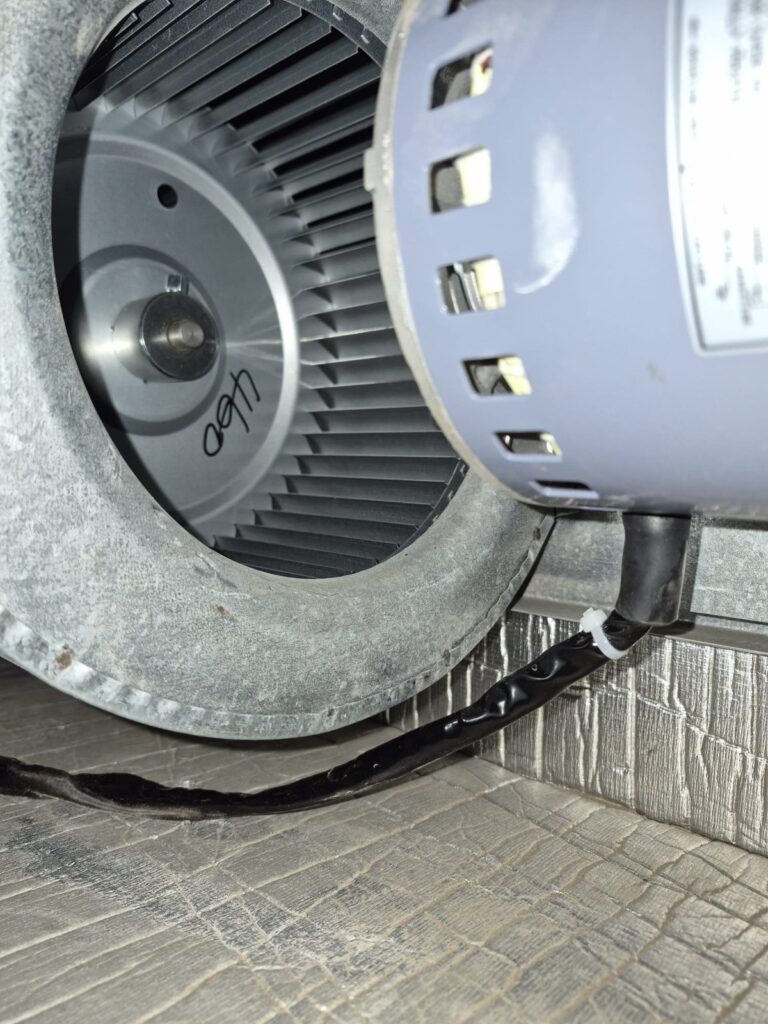
On the repair visit we replaced both indoor fan motors with 550 W (3/4 HP) single-phase motors and fitted a new 9-inch by 9-inch, half-inch bore, clockwise-rotation impeller. Both 10 microfarad run capacitors were replaced at the same time.
With the unit partially disassembled, we completed a chemical clean of the indoor coil. To access the coil properly, we removed the return air duct from the unit. That process revealed that the duct material itself is deteriorating. The plastic is breaking down and will continue to do so. We cut out the worst-affected section, but the full return air duct run requires replacement. A separate quote has been issued.
After reassembly the unit was test-run. Both indoor fans are spinning correctly.
| Stage | What we did | What it showed |
|---|---|---|
| Initial service visit | Checked capacitors; inspected outdoor unit and indoor fan motor; cleaned filters; test-ran unit | Rubber motor mounts deteriorating; rattle traced to the indoor unit |
| Quote | Prepared scope: both motors, impeller, capacitors, coil clean | Customer approved |
| Repair: fan assembly | Replaced 2 x 550 W indoor fan motors; 1 x 9-inch by 9-inch impeller (half-inch bore, CW); 2 x 10 uF capacitors | Indoor fans spinning nicely |
| Repair: coil clean | Removed return air duct; chemically cleaned indoor coil | Return air duct plastic found deteriorating; worst section removed; full replacement quoted |
| Test run | Operated unit after reassembly | Unit running, indoor fans spinning nicely |
Key Takeaways
- A loud rattling or vibrating noise from a ducted system in the roof cavity is worth investigating at the first service. Worn rubber mounts left in place can allow further contact damage inside the unit over time.
- Filters are something homeowners can check and clean themselves at the return air grille. A clogged filter forces the fan motor to work harder and raises operating temperatures, which accelerates wear on rubber mounts and motor windings alike.
- If the noise changes from a rattle to a grinding or squealing sound, or the system stops cooling effectively, switch it off at the isolator and call a technician before running it again.
- Any work involving the refrigerant circuit requires a technician holding a current Refrigerant Handling Licence issued by the Australian Refrigeration Council (ARC).
- When a unit is opened for a major repair, secondary issues often become visible. Annual air conditioner servicing improves the chance of catching problems early, before they reach the point of a complete fan assembly renewal.
The Resolution
Both indoor fan motors and the blower wheel have been replaced. The indoor coil has been chemically cleaned. The unit was test-run after reassembly and the indoor fans are spinning nicely. A quote for replacing the return air ducts is with the customer: the duct material is degrading and will continue to do so if left in place.
If you are weighing up whether to repair or replace your ducted system, our calculator is a practical starting point.
“On an older ducted system, a vibrating noise from the roof is rarely just one thing. Open the unit and you often find several components that have worn together. Dealing with them in one visit costs less than coming back for each one.” Oliver Hastings, T&K Airpower
This job was in Mawson Lakes. We look after homes right across the City of Salisbury: see air conditioning repairs in Salisbury.
Frequently Asked Questions
Why is my ducted air conditioner making a rattling or vibrating noise from the roof?
The most common cause is a fault in the indoor fan assembly located in the roof cavity. Worn rubber anti-vibration motor mounts allow the motor to rock under load and transfer vibration to the unit casing and ceiling framing. A loose or damaged blower wheel or a failing capacitor can produce a similar sound. A service inspection will confirm the source.
Is it safe to keep running a ducted air conditioner that is rattling?
It should not be left running indefinitely. A motor with deteriorated mounts can cause contact damage inside the unit over time. If the noise changes to a grinding or squealing sound, or the system stops cooling properly, switch it off at the isolator and call a licensed technician before running it again.
How much does it cost to replace a ducted air conditioner fan motor in Adelaide?
Costs vary depending on motor size, the number of motors, access in the roof cavity, and what else needs replacing at the same time. As a guide, a scope covering two indoor fan motors, an impeller, run capacitors, and a coil clean on a Temperzone ducted system ran to about $4,000 to $4,500 inc GST in October 2026. A ducted service visit is $290, and air conditioner fault finding is a $199 diagnostic. For a full assessment, call us on 08 8296 7888 or use our repair-or-replace calculator as a starting point.
Can I fix a rattling ducted air conditioner myself?
Cleaning the return air filter and checking that the grille is clear are tasks a homeowner can do safely. Anything beyond that, such as opening the unit to access the fan motor, blower wheel, or capacitors, involves live electrical components and potentially the refrigerant circuit. This work requires licensed tradespeople. Attempting it without the correct licences is a safety risk and may void the system warranty.
Why do ducted air conditioner motors fail in Australian roof spaces?
Roof cavities in Australia can reach very high temperatures in summer. That thermal load degrades rubber components such as motor mounts, accelerates wear on electrical insulation, and ages capacitors faster than in a conditioned environment. Systems running heavily through Adelaide summers accumulate significant operating hours and heat exposure. Regular servicing helps catch early signs of wear before they become a complete failure.
What is a blower wheel (impeller) and why was it replaced on this job?
The blower wheel is the rotating fan inside the indoor unit that draws return air across the coil and pushes conditioned air through the duct system. When rubber motor mounts deteriorate and allow abnormal motor movement, the wheel can come out of balance or sustain damage, amplifying vibration and noise. On this job the impeller was replaced alongside both motors as part of a complete fan assembly renewal.
What else might be found when a ducted unit is opened for a major repair?
Opening a ducted indoor unit for motor replacement often reveals conditions not visible from outside. On this job, removing the return air duct to access the coil showed that the duct material was breaking down. Duct material, return air connections, and coil condition are all worth assessing while the unit is partially disassembled. Annual air conditioner maintenance improves the chance of catching these issues before they become urgent.
Need Help?
If your ducted system is making a noise you are not happy with, or it is due for a service, call us on 08 8296 7888 or get in touch online. T&K Airpower has been repairing air conditioners in Adelaide since 1996. We are licensed, insured, and authorised warranty agents for Temperzone, Mitsubishi Electric, and Hitachi. We repair first.

